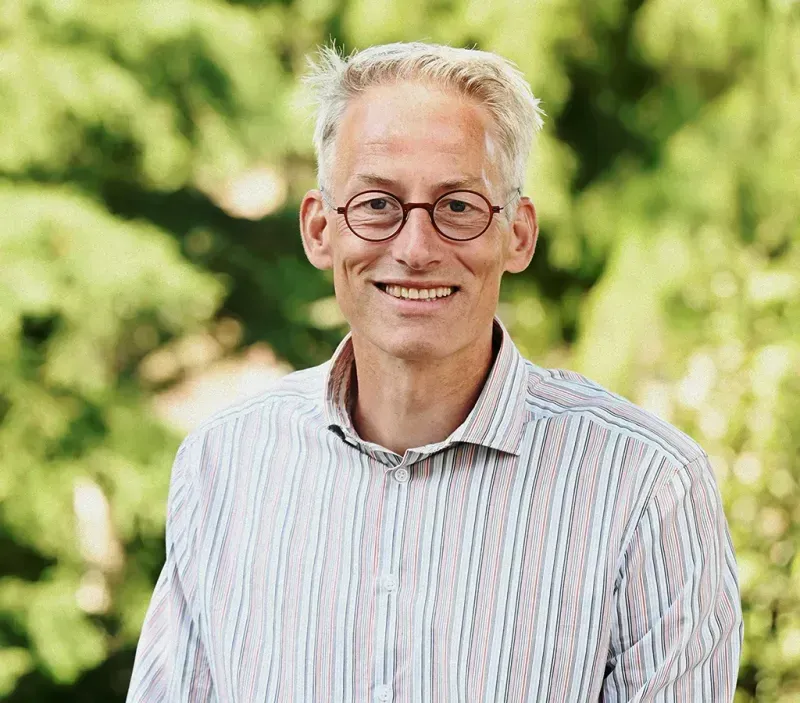
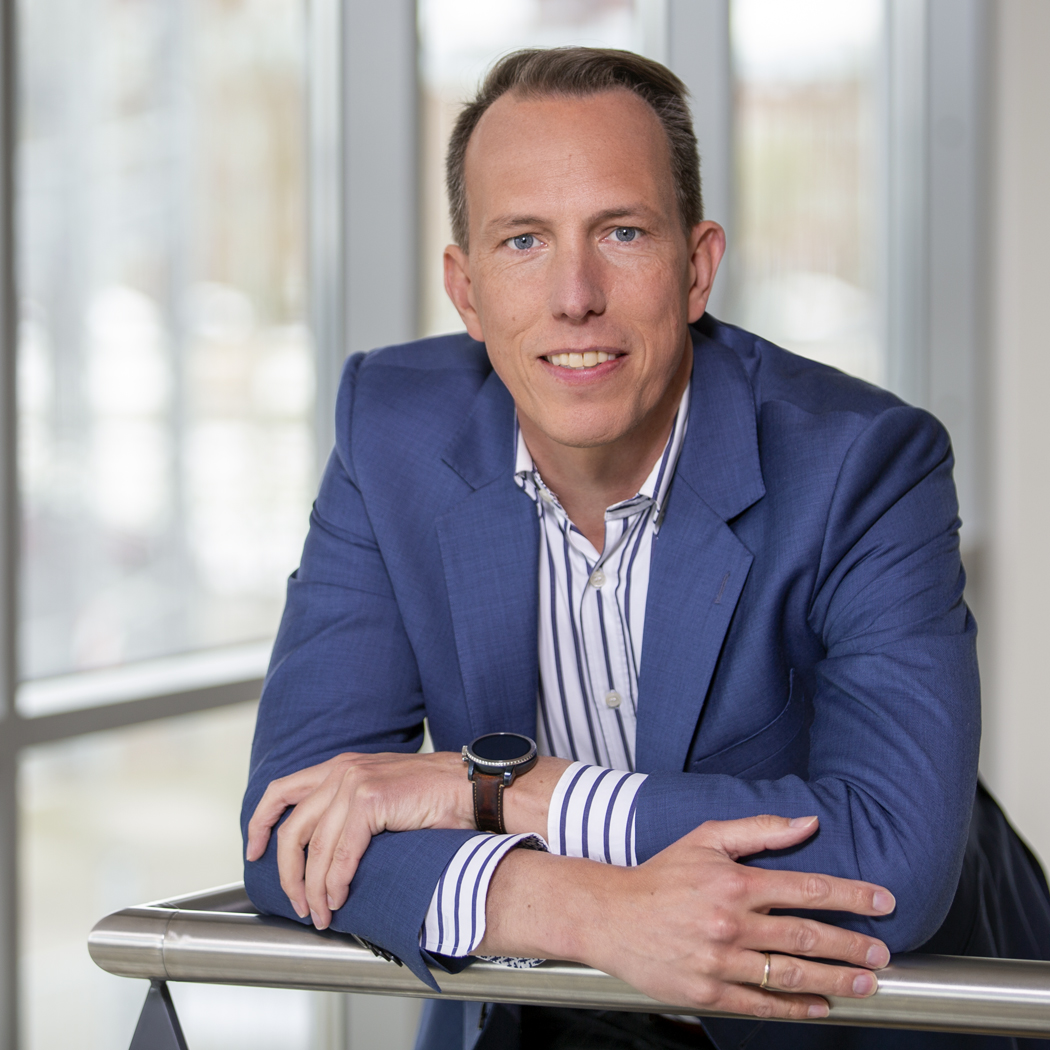
In conversation with Gert-Jan van Wijk, Sander van Muijen reflects on his career and personal development. He works as an executive team coach, advisor in Leadership & Change, researcher (Executive PhD candidate at Vrije Universiteit Amsterdam), and core lecturer in Change Management at Nyenrode Business Universiteit.
At the beginning of Sander’s career, he worked as a nurse. At his first staff party in the hospital, a fellow nurse immediately made him aware that there were differences between doctors and nurses. “Sander, you’re wearing a doctor’s shirt.” What Sander saw simply as a nice shirt turned out to be a status symbol associated with doctors. And this distinction was maintained by both doctors and nurses.
Today, Sander refers to this as a “complicit system”: a situation in which hierarchy, norms, and distance between groups are maintained in ways that prevent better collaboration. You can focus your attention on one group, for example the doctors and why they make collaboration more difficult, but doctors and nurses sustain this dynamic together at a systemic level. This is precisely what makes it interesting to explore when you want to improve collaboration between doctors and nurses.
Sander works with executives and their teams on major transformations. When they define the approach to change together, it is not always natural for executives and their teams to also look at themselves. “Could it be that you are part of the problem?” is what he tries to help them recognize, without asking the question quite so directly. Most questions, after all, are about all the other people involved in the transformation.
“I see in practice that these changes move faster when the leadership team also looks in the mirror and seriously explores how they need to act differently to enable the transformation. The paradox is that the leaders who need this leadership development the most, are often the ones who ask for it the least. Because you do not know, what you don’t know and what you are missing, or what could be done differently.”
Sander draws inspiration from developments in the Human Factors field within the aviation industry, where it has long been common practice not only to look at mistakes a pilot might make (“pilot error”), but also at the entire system that contributes to making the mistake possible (“latent error”).
So what are the implicit and explicit expectations between the executive team and employees that remain unspoken or undiscussed, causing the transformation to stall later on? If the choice of your shirt at a party is already determined by your role, how can you expect nurses to challenge doctors about potential mistakes? Or transformation teams to challenge their executive sponsor?
When does change become sustainable improvement?
(with thanks to Edgar Karssing, Nyenrode)
“I see myself as a partner in clarifying the assignment. I help my client and their team look at the challenge and the core question from different perspectives. After that, I stand alongside my client (a leader or leader with a team) and become a partner in executing the assignment. The key question is always: when do we switch to partnership? Otherwise, by definition, you are not truly helping.
Questions that can help are:
- Who am I within the system? What do I bring with me?
- What effect does the system have on me?
- What effect do I have on the system?
- What helps the larger system (the organization) move closer to achieving its purpose? What is the intended added value for customers and society?
- Where do I need to start, and what do I need to stop doing?”
Sander finds inspiration in a wide variety of sources: music, faith, science, the community of practice of team coaches, and nature. “The earth is an incredible, living work of art. I experience that every time I walk along the beach or through the forest. Or when I look at the underground growth of a tulip, and the beauty of its flowers in all their diversity of colors and structures. You can see that as an expression of the Creator — that is how I see it as well.
And that is also how I want to look at my clients: the people at the top of organizations whom I am allowed to guide for a short period of time — in their own development, which ultimately affects the senior team and the entire organization.
I believe that we most resemble the Creator in the creativity we have been given. Yet, as human beings, we struggle most with putting our good intentions into practice. Turning intentions into behavior is what makes this profession so fascinating and so difficult.
We are beings with the potential to build deep and meaningful relationships. That is a beautiful, and at the same time a deeply painful, potential when I look at the world. Our work is therefore an antidote: by treating each other well. Not only the people within our own bubble, but especially by continuing to build bridges with people with whom we have less contact or even less affinity.
This matters because the trend is that these bridges are becoming fewer and shorter. So: continue developing yourself, and keep searching for the boundaries of your own thinking and understanding.”
“Once you reach the boundary of your thinking, it is no longer your boundary.”
Sander also sees himself as a work in progress, through the combination of his work and his PhD research into the human side of executive teams — especially during challenging periods of change.
“I have deep respect for everyone who has the courage to look in the mirror, professionally and personally. I also want to continue embracing my own development as a human being — with everything that makes life beautiful, rich, painful, and complex. No matter how difficult that may be.
Perhaps that is the essence: not wanting to appear bigger or better than you are, but daring to be honest about what life, leadership, and change truly ask of you.”